MIPHACARE FOR PROVIDENCE HEALTH CARE REVIEW
Physics-led medical AI & engineering · Vancouver, Canada

Intelligent healthcare. Connected from hospital to home.

MiPhaWell AI brings together an established iOS mobile application, the MiPhaWell System Layer (MSL) backend for edge or cloud deployment, and two flagship programs: MiphaCare clinical intelligence research and MiPhaOne investigational neuromodulation. Our goal is to connect patient information, healthcare teams, and intelligent services across care settings.

Explore our programs →
See how MiphaCare and MiPhaOne approach two different healthcare challenges.
Explore connected care →
Discover our iOS application, MSL backend, and connected-care architecture.
Research arrangement with Providence Health Care · Retrospective ICU evaluation in preparation, subject to required research approvals.
Our flagship programs

Two distinct programs. One evidence-led engineering discipline.

Model complex systems, test assumptions, and build toward technologies clinicians can evaluate responsibly.

01 / Clinical AI research

MiphaCare

Deterioration rarely happens all at once. It develops across heart rate, breathing, oxygen levels, and clinical context. MiphaCare is designed to model each patient’s trajectory over time, identify emerging risk patterns, and present interpretable information to the clinicians responsible for care.

Patient trajectoriesEarly-warning researchClinical dashboardsDecision support
“The Drift” — how deterioration builds graduallyLearn more about MiphaCare →
Research areas, evaluation pathway, current status, and FAQs.

How patient deterioration builds across vital signs, and why trends matter more than a single reading. Illustrative animation.

Research stage. Current demonstrations use synthetic data; clinical performance has not been established.

02 / Hardware prototype developed

MiPhaOne

MiPhaOne is an investigational non-invasive neuromodulation program. Its initial computational physics, mathematical modeling, simulation research, engineering design, hardware development, and prototype implementation phases are complete. The next stage focuses on experimental performance verification and safety evaluation.

Computational physicsHardware prototype developmentEngineering research
From physics to hardware. Advancing toward clinical research.Learn more about MiPhaOne →
Explore our completed computational research and hardware prototype development, upcoming experimental verification, and planned clinical research pathway.

From computational modeling and engineering design to hardware prototype development. Conceptual research illustration.

MiPhaOne conceptual neuromodulation research illustration

MiPhaOne · Computational research and hardware prototype development

Hardware prototype development completed. Experimental performance verification and safety evaluation are the next stages. MiPhaOne remains investigational.
MiPhaWell AI connected-care ecosystem

One mobile experience. Flexible edge or cloud infrastructure.

Our established iOS application and MiPhaWell System Layer (MSL) backend provide a software foundation for connected healthcare experiences. They complement MiphaCare's clinical intelligence research and our broader healthcare technology roadmap.

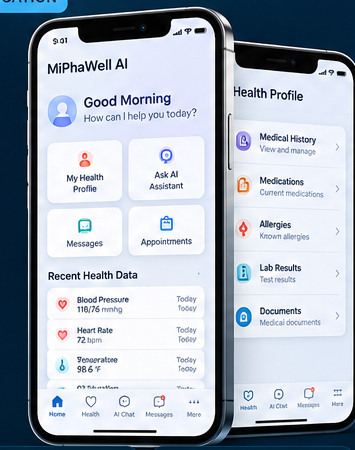
Illustrative mobile healthcare app concept, not an actual application screenshot

MiPhaWell AI Intelligent Mobile Application

A functioning iOS application, already used by people on supported Apple devices, designed around personalized health information and intelligent interaction.

  • Personal medical profiles, medication and allergy information
  • AI-assisted health questions and contextual information
  • Health measurements and longitudinal patient context
  • Foundation for connected patient–clinician experiences
Developed iOS application · Existing user experience
Illustrative edge and cloud server infrastructure, not a photograph of MSL deployment

MiPhaWell System Layer (MSL)

MSL is an existing backend server system that can be deployed in an edge environment or hosted in cloud infrastructure such as Amazon Web Services (AWS).

  • Server-side communication and networking foundation
  • Edge-hosted or cloud-hosted deployment options
  • Integration pathway for mobile applications and backend services
  • Foundation for future hospital-to-home monitoring workflows
Developed backend software · Edge / cloud deployment

Existing software and prior usage do not establish clinical validation. Advanced predictive alerts, emergency access, care-team permissions, and interruption-tolerant monitoring require feature-specific verification and appropriate safety and privacy controls.

Evidence before claims

Where our research stands

MiPhaWell AI is preparing a retrospective research evaluation of MiphaCare’s predictive methods using ICU data through a research arrangement with Providence Health Care in British Columbia. The evaluation remains subject to applicable research ethics, privacy, governance, contractual, and data-access approvals.

See where our research stands →
Explore the research pathway and current stage of retrospective ICU evaluation.
01
Model and simulateBuild technical concepts and synthetic research demonstrations.
02
Evaluate rigorouslySeek authorized retrospective assessment and reproducible validation.
03
Engineer responsiblyAdvance hardware, usability, and safety work through appropriate testing.
04
Support cliniciansDesign for oversight, explainability, and human decision-making.
Explore our technology

From clinical workflows to ICU research.

Explore interactive development and research demonstrations. Interfaces and sample patient information are illustrative and do not establish clinical deployment or validated outcomes.

MIPHAWELL AI CLINICIAN WORKSPACE
Patient context
AI brief
Care workflow
✦   Profile · Alerts · AI Assistant
Development demonstration

Clinical Intelligence Platform

A doctor-facing workspace exploring patient context, AI-assisted summaries, medication review, communication, voice interaction, and emergency-profile workflows.

Request a guided demo →
Explore patient context, AI-assisted summaries, medication review, and care communication with our team. For clinicians, researchers, and partners.
MIPHACARE ICU SYNTHETIC DATA
Risk trajectories · Explainability · Clinician review
Synthetic ICU research demo

ICU Risk & Outcome Research

Explore illustrative patient acuity ranking, device-infection risk trajectories, outcome estimates, and model-explanation views. Numbers in the walkthrough are not clinical validation evidence.

Request a guided demo →
See illustrative risk trajectories, acuity ranking, and model explanations using synthetic ICU data.
MIPHAWELL AI VOICE + CHAT
What is MiphaCare?
Research-stage clinical intelligence and connected-care technology.
Guided demonstration available

MiPhaWell AI Assistant

Conversational exploration of MiPhaWell AI's technologies, development programs, and product vision, with voice-enabled interaction.

Request a Guided Demo →
Request a guided walkthrough of our MiphaCare clinical workspace or ICU research dashboard. All demonstration patient data is synthetic.

Connected healthcare technology

From mobile applications to connected clinical intelligence.

The existing MiPhaWell AI iOS application and MSL edge-or-cloud backend are foundational software components. The capabilities below describe additional platform integrations and research areas at varying stages of maturity.

Development status: Research — under investigationSimulation — computational modelsPrototype — development-stage softwarePlanned — not yet implemented
Prototype

iOS health application

Patient profiles, symptom information, medication context, and health-data experiences developed for Apple devices.

Prototype

Health data integration

Architecture for longitudinal vitals, wearable measurements, and contextual health information, including Apple Health integrations.

Research

AI services

Modular services for health information, risk modeling, recommendations, and clinical decision-support research.

Prototype

Cloud backend

Containerized microservices and APIs designed to support extensible healthcare application workflows.

Research

Clinical interfaces

Dashboard concepts for hospitals and physicians to review patient trajectories, alerts, and clinical context.

Planned

Connected care experiences

Physician-patient communication and video-visit workflows within the broader product roadmap.

Designed around healthcare teams

Clinical signals, physician oversight, and patient context.

Our development priorities are shaped by the distinct needs of clinicians, researchers, and individuals managing their health.

Hospitals & clinical teams

Research into interpretable patient trajectories, early warning, and clinician-reviewed decision support.

Physicians & care providers

Tools and concepts for longitudinal context, patient review, and connected care interactions.

Patients & individuals

Mobile-first access to health profiles, measurements, and understandable personal health information.

About MiPhaWell AI

A physics-first approach to healthcare technology.

MiPhaWell AI is a Vancouver-based, physics-led health technology company advancing two research programs: MiphaCare, a clinical AI platform designed to identify emerging patterns of patient deterioration by tracking individual patient trajectories over time, and MiPhaOne, an investigational non-invasive neuromodulation program that has progressed through computational physics, mathematical modeling, simulation research, engineering design, and hardware prototype development.

Our guiding principle is simple: healthcare technology should be modeled before it is built, tested before claims are made, and designed to keep clinicians in control. We apply the discipline of physics and engineering—defining systems, measuring rigorously, and validating against evidence—to healthcare challenges where patient safety matters most.

MiphaCare is preparing for a retrospective research evaluation using ICU data through a research arrangement with Providence Health Care in British Columbia, subject to applicable research ethics, privacy, governance, and data-access approvals. MiPhaOne has completed its initial computational research, engineering design, hardware development, and prototype implementation phases. The next stage focuses on experimental performance verification and safety evaluation, with hospital research collaborations and clinical investigations planned for future stages, subject to the necessary approvals.

Founder & CTO

Dr. Seyed Sharif

Dr. Seyed Sharif is a PhD physicist, technology entrepreneur, and inventor named on approximately 40 patents. He leads MiPhaWell AI's clinical AI architecture and physics-based engineering research.

1999–2002L3 Technology · Co-founder & Chief Scientist
2002–2009Mobidia · Co-founder & Chief Scientist
Dates under reviewmimik · Co-founder & CEO
TodayMiPhaWell AI · Founder & CTO
Let's build what's next

Explore a research collaboration.

We welcome conversations with hospitals, clinical researchers, engineering partners, and investors. Email us to discuss research collaborations and demonstrations.

Email our team →
Request a demo →
Prefer to see it first? Request a guided walkthrough.
Tell us about your organization and your interest in research, clinical collaboration, engineering, or investment.

Request a Guided Demo

Tell us what you would like to explore. We will contact you to discuss a walkthrough.

Please do not include patient information or sensitive medical details. We use your information to respond to your inquiry.

Or email us directly →